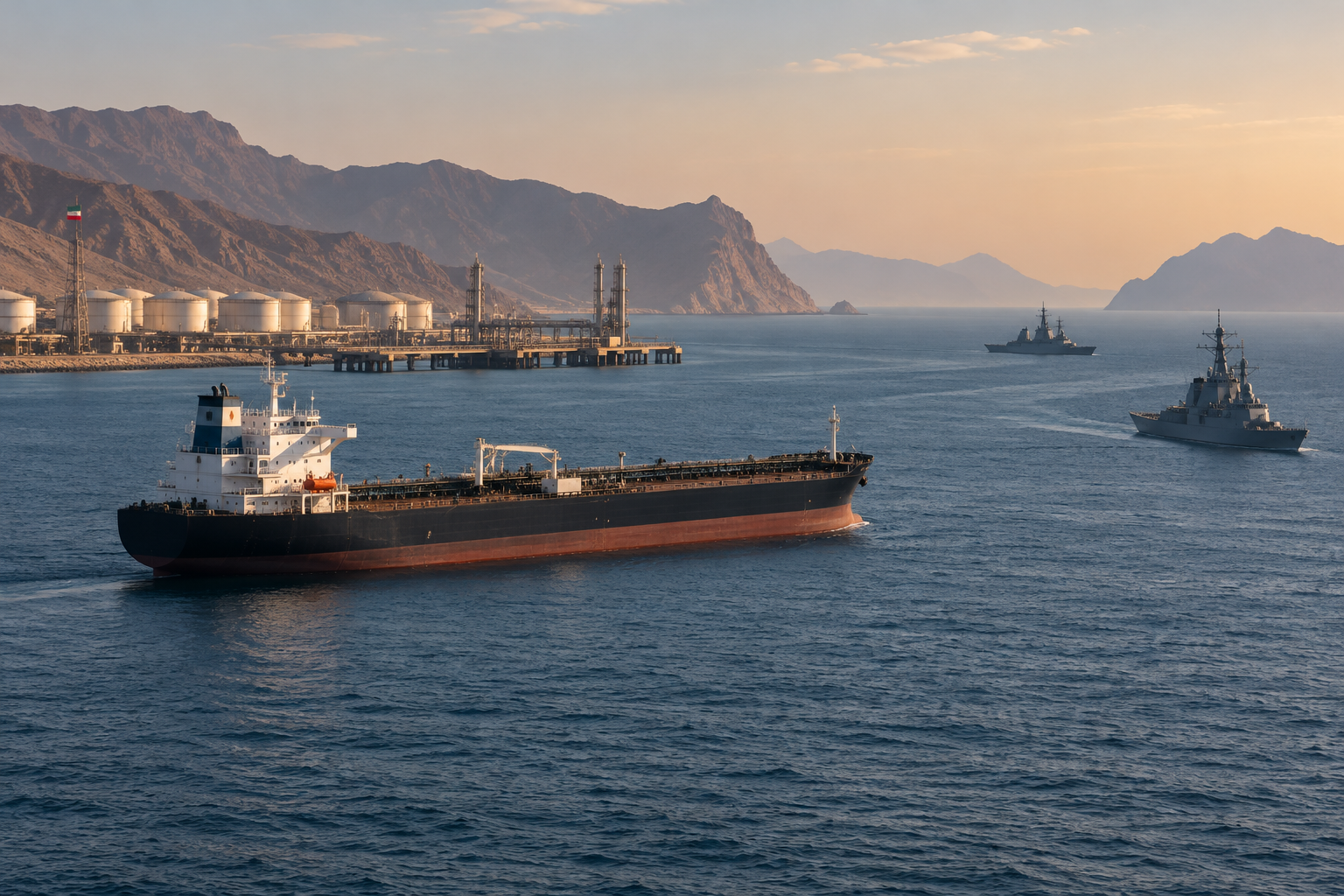
Stopping a tanker and making its route safe are different achievements. That distinction sits at the heart of the confrontation around the Strait of Hormuz. Iran has threatened shipping through the narrow passage connecting the Persian Gulf to the ocean. The United States has targeted trade entering and leaving Iranian ports. These overlapping campaigns put pressure on different parts of the same trading system—and success in one does not guarantee success in the other. [1] [4]
Two kinds of leverage
Think of the strait as a shared driveway. Iran’s leverage comes from making passage dangerous for others. Attacks and threats can disrupt oil movements and pressure governments that depend on Gulf supplies. Reporting describes Iran as having effectively closed the corridor after U.S. and Israeli attacks on February 28, 2026. [2] [4]
The American blockade operates differently. Its announced scope covers ships entering or leaving Iranian ports, regardless of nationality, while permitting traffic serving other countries. Rather than placing a physical barrier across the strait, forces identify relevant vessels, track them and intercept them farther out. The initial enforcement began on April 13 in the Gulf of Oman and Arabian Sea. [1]
The strategic logic is to deny Iran income from its own maritime trade while it obstructs its neighbors’ trade. Humanitarian food and medical shipments are supposed to pass after inspection. That exemption describes the intended rules; it is not evidence that all humanitarian needs are being met. [1]
How an export squeeze works
Oil-export restrictions create two connected pressures. The first is financial: fewer sales mean less foreign currency available to the Iranian government. The second is physical. If oil keeps coming out of the ground but cannot leave by ship, storage eventually fills. Production must then be reduced or wells shut down, and some wells can be difficult to restart. [1]
Those mechanisms explain why intercepting ships can matter beyond the intercepted cargo. But they do not establish how much pressure will change a government’s decisions. The intended outcome is a shift in Tehran’s negotiating calculations, not merely a growing tally of vessels turned away. [1] [3]
Evidence of enforcement, uncertainty about results
Early shipping data independently showed some Iran-linked vessels stopping or reversing course. Verification was nevertheless complicated by tracking signals that were switched off or falsified. Such observations indicate that enforcement affected some voyages; they do not provide a complete accounting of trade prevented. [1]
On October 16, CENTCOM commander Adm. Brad Cooper said the blockade had prevented $25 billion in Iranian oil exports. He also said U.S. forces had helped 400 merchant vessels pass through the strait during the preceding week. AP reported those statements, but the figures remain military claims—not independent confirmation of the export calculation or a return to normal shipping conditions. [2]
Diplomacy offers another, narrower indicator. On October 18, AP reported that Iran was reviewing Washington’s response to its latest proposal. Foreign Minister Abbas Araghchi had offered reopening in exchange for lifting the blockade, releasing frozen assets and waiving oil sanctions, among other conditions. This makes the blockade a visible bargaining issue. It does not show that Iran has accepted American terms. [3]
The harder task: reassuring ships
The strategy’s central limitation is asymmetry: threatening commercial shipping can be easier than protecting it. Concealed missiles, drones and credible threats can deter operators without Iran defeating the U.S. Navy. The United States escorted tankers during the 1980s Iran–Iraq war, but today’s threats complicate protection. Economic pressure and safe passage therefore remain separate tests. A blockade can stop ships without securing the waterway—or producing a political settlement. [4] [3]
Sources
- [1] How a US blockade on Iran has sanctioned ships turning around - WTOP News
- [2] CENTCOM chief: US has blocked Iran from exporting $25b worth of oil | The Times of Israel
- [3] Airstrike kills at least 9 in Yemen and other Middle East developments | AP News
- [4] Bigger US military presence needed to secure Strait of Hormuz, experts say | AP News