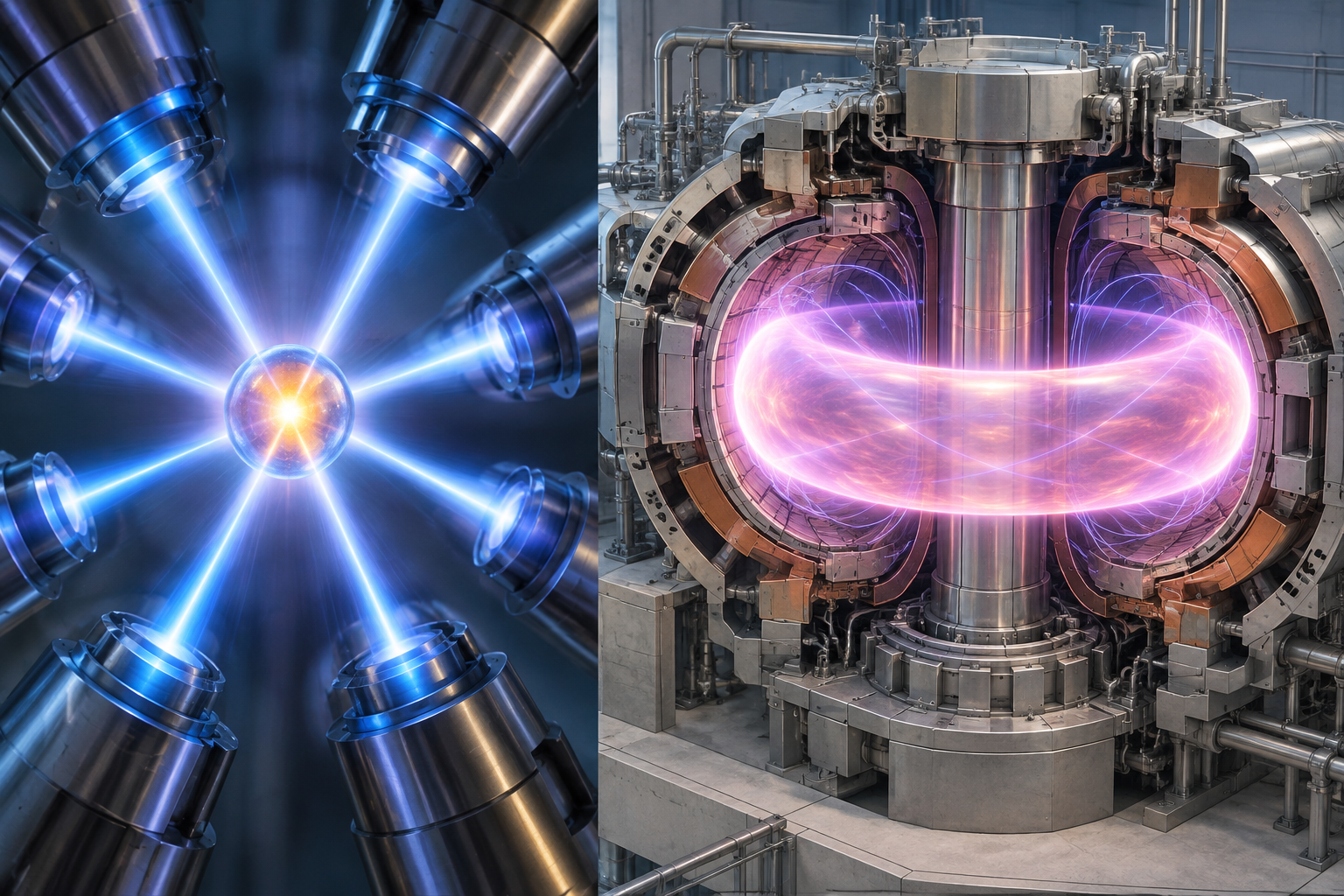
A fusion experiment can release more energy than reaches its fuel and still fall short of powering the building around it. That distinction is central to understanding fusion’s recent headlines. Researchers have achieved genuine breakthroughs, including repeated laser-driven ignition. But the evidence reviewed here does not establish that an integrated fusion power plant has exported electricity after covering its own energy needs. [1] [3] [8]
So is fusion power getting closer? Scientifically, yes. On the calendar, the answer is less reassuring: important demonstrations remain targets, some schedules have slipped, and the engineering needed for dependable electricity is unfinished. The evidence has improved more clearly than the timetable. [1] [2] [5] [8]
What the breakthroughs actually prove
At Lawrence Livermore National Laboratory’s National Ignition Facility, lasers compress a small capsule of hydrogen-isotope fuel. On December 5, 2022, an experiment released 3.15 megajoules of fusion energy after 2.05 megajoules of laser energy reached the target. On April 7, 2025, the fusion output reached 8.6 megajoules, with a reported uncertainty of 0.45 megajoules, from 2.08 megajoules delivered—a target gain of 4.13. [1]
Those are measured experimental results, not simulations or investment announcements. Yet that gain calculation excludes the electricity required to operate the lasers and facility. It demonstrates progress in laser-driven ignition, not a power station’s overall energy balance. Repeated ignition is important; sustained electricity production is a different test. [1] [3]
Magnetic fusion has made tangible hardware progress, too. Researchers at MIT and Commonwealth Fusion Systems tested a roughly three-metre-scale superconducting magnet reaching about 20 tesla in September 2021; detailed results appeared in peer-reviewed papers in March 2024. This is enabling technology for compact magnetic-confinement machines. But a successful magnet does not establish the performance of a complete reactor—or the economics of a future power plant. [4]
Read the milestone, not just the date
Commonwealth Fusion Systems targets fusion gain above one in its SPARC machine in 2027. That would be a magnetic-confinement physics demonstration, not electricity supplied to the grid. The company distinguishes SPARC from its proposed electricity-producing successor. The experimental milestone is a company goal, not an achieved result or a dependable delivery date. [2]
Even the meaning of success can change. Helion’s Polaris prototype page says the company previously described its goal as net electricity. It now describes demonstrating electricity from fusion by converting some fusion energy into electricity stored in a capacitor bank. That would not, by itself, demonstrate more electricity produced than the machine consumes. [6]
Meanwhile, ITER’s planned deuterium–tritium operation has moved from 2035 to 2039. Its old 2025 first-plasma milestone and new 2034 start of research operations describe different levels of machine readiness, so treating them as equivalent is misleading. The four-year shift in the deuterium–tritium phase, however, is a real delay. [5]
The power plant is the next test
Beyond plasma performance, components must tolerate heat, particle bombardment and neutron exposure while remaining maintainable. A 2026 materials review identifies unresolved development needs; the research memo examined only its abstract and citation record, so it cannot establish how much delay those needs might cause. Deuterium–tritium plants also need fuel recovery, recycling and ultimately a self-sufficient tritium cycle. DOE’s roadmap places an integrated fuel-cycle demonstration among its five-to-ten-year objectives—not among completed achievements. [7] [8]
These systems must also work together. DOE identifies the absence of a validated, end-to-end plant-level modelling environment alongside experimental and engineering gaps. That does not prove an early plant is impossible. It does explain why a successful plasma experiment alone cannot settle a power plant’s delivery date. [8]
DOE’s finalized June 2026 roadmap supports commercial fusion in the mid-2030s. It is a development strategy, not a validated completion schedule; implementation depends on partnerships and congressional appropriations. First electricity in the 2030s is a serious possibility, not a promise. Dependable, competitively priced fusion at scale still has no defensible date. The next headline deserves a practical question: what did the machine actually demonstrate? [8] [9]
Sources
- [1] Achieving Fusion Ignition | Extreme Light, Matter, and Fusion
- [2] SPARC: Proving commercial fusion energy is possible | Commonwealth Fusion Systems
- [3] Lab Report: May 23, 2025 | Lawrence Livermore National Laboratory
- [4] The SPARC Toroidal Field Model Coil Program
- [5] (100 kiloAmperes), using only hydrogen, to be followed immediately by assembly and operation in four successive stages, reaching full plasma current (15 MegaAmperes, 150x higher current than in the First Plasma of the 2016 Baseline) later, in 2033. These constraints were unavoidable because key components were not available for assembly before 2025: for example, the divertor that functions to absorb high heat loads, the shield blocks that protect the vacuum vessel, and more.
- [6] Helion | Polaris
- [7] The U.S. Fusion Materials Community Roadmap: Near-term research priorities for the development of plasma-facing and structural materials for fusion power plants | Journal Article | PNNL
- [8] Published June 2026
- [9] Energy Department Releases Finalized Fusion Science and Technology Roadmap to Accelerate Commercial Fusion Power | Department of Energy