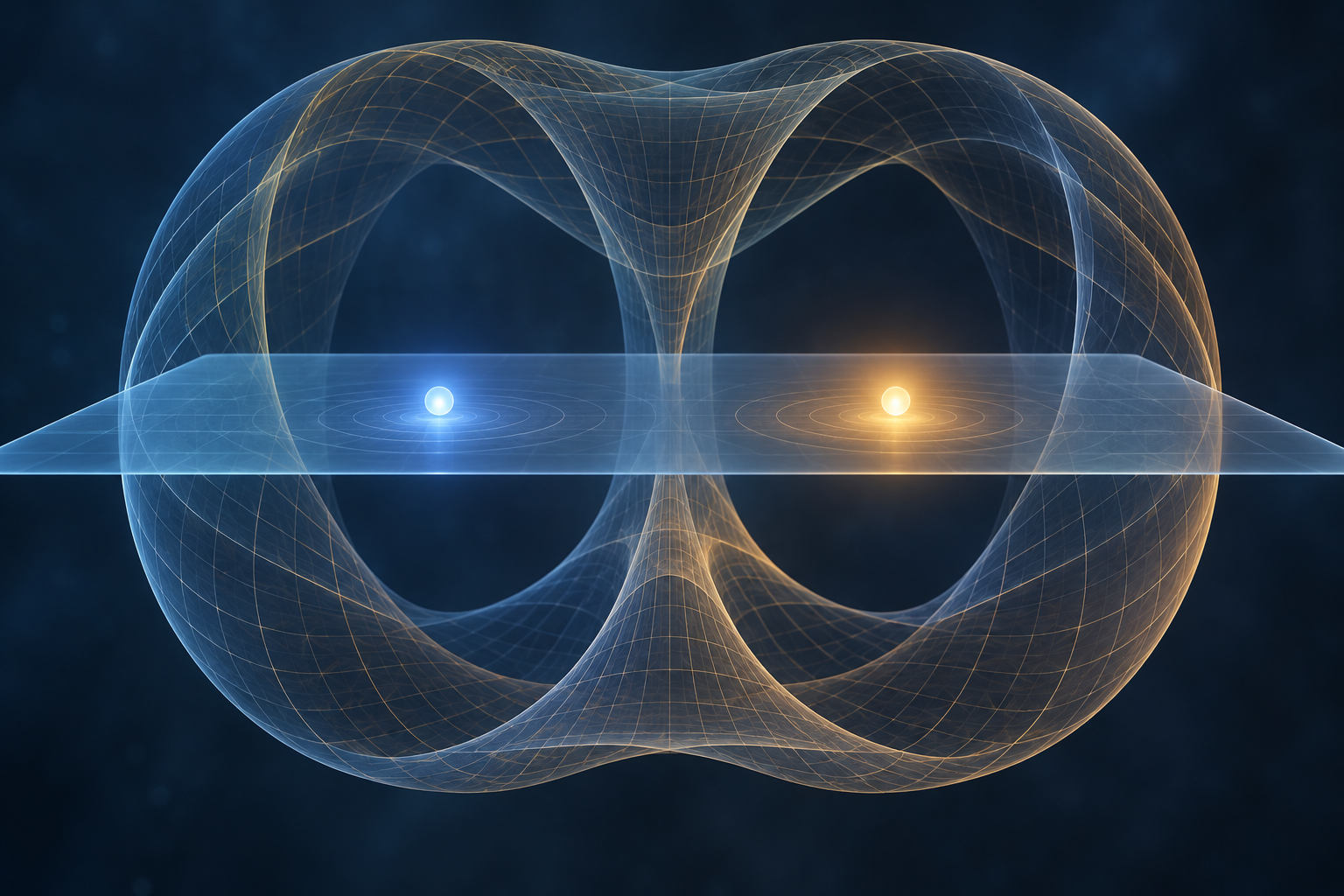
What if two particles seem mysteriously connected because we cannot see the full geometry behind them? It is an inviting way to picture quantum entanglement—and researchers have explored related ideas. Some theoretical work uses higher-dimensional descriptions; other proposals connect entanglement with wormholes. But these approaches do not establish that extra spatial dimensions cause the correlations measured in laboratories. [1] [3] [5]
First, set aside the image of a particle vanishing here and reappearing elsewhere. Entanglement concerns unusual statistical relationships between measurements of separated systems. Experiments establish those correlations, but they do not provide a way to send controllable messages faster than light. The question here is how to understand those relationships, not where disappearing particles went. [2]
A mathematical proposal, not a detected dimension
A particularly direct example is Allan Kardec Barros’s paper, Emergent quantum entanglement from higher-dimensional geometric projection, published in Results in Physics in October 2026. It proposes that physical states inhabit a higher-dimensional mathematical space, while observable states arise through a coherent projection into ordinary spacetime. Within this construction, initially separable higher-dimensional states can yield entangled observable states. [1]
The abstract reports that the framework recovers standard quantum correlations under suitable coherence conditions. It also predicts a possible additional dependence on measurement angles when those conditions are imperfect. That could offer a proposed test—but it is not a reported successful test. The publisher’s data statement says no data were used: this is theoretical research, not a detection of another spatial direction. [1]
An important limitation applies to this assessment. The research review accessed the publisher’s abstract, highlights and data statement, not the complete paper. Those materials cannot support an independent check of the full derivation, or establish whether the suggested signature would uniquely distinguish the framework from conventional alternatives. [1]
When another dimension helps with the mathematics
Related mathematics has a longer history. In work first posted as a preprint in January 2007, Vlatko Vedral used a correspondence between quantum and classical statistical physics. His worked example represented properties of a one-dimensional quantum spin chain—including information needed to calculate entanglement—through a two-dimensional classical Ising model. [3]
But representing a system using an additional dimension does not demonstrate that this dimension physically exists. Vedral explicitly left open whether it was a calculation tool or could have physical meaning. He also stated that the construction did not overturn Bell’s restrictions on local hidden-variable explanations. [3]
A different geometric connection appears in Juan Maldacena and Leonard Susskind’s 2013 theoretical proposal, known as ER = EPR. Certain entangled black-hole states have a description involving an Einstein–Rosen bridge, or wormhole. Extending that picture to ordinary entangled spins was explicitly speculative. The bridges discussed also do not provide a route for messages between the two exterior regions. [4] [5]
The experimental hurdle
Any explanation must account for what Bell experiments observe. In 2023, Simon Storz and colleagues reported a loophole-free test using superconducting qubits connected through a roughly 30-metre cryogenic link. Across more than one million trials, they measured a Bell parameter of 2.0747 ± 0.0033, exceeding the local-model bound of 2. [2] [6]
Adding unseen dimensions does not automatically bypass this constraint. An explanation satisfying Bell’s local-causality and measurement-independence assumptions must obey the inequality. A geometric explanation must therefore specify how it reproduces the violation without satisfying all those assumptions. The experiment closes major experimental loopholes, but retains assumptions about its spacetime arrangement and independent measurement choices; it does not select one ultimate interpretation of quantum mechanics. [2] [6]
Even the word “dimension” needs care. A 2020 silicon-chip experiment created three-dimensional entanglement using qutrits: quantum systems with three distinguishable state alternatives. Here, dimension concerns quantum state space—not an extra direction in physical space. Real higher-dimensional entanglement experiments need not imply hidden spatial dimensions. [7]
The research supports a qualified answer: higher-dimensional descriptions and geometry offer genuine theoretical approaches to entanglement. But a useful mathematical representation, a proposed physical explanation and an experimentally established mechanism are different achievements. These sources support exploring the idea, not declaring it confirmed. [1] [3] [5] [6]
Sources
- [1] Emergent quantum entanglement from higher-dimensional geometric projection - ScienceDirect
- [2] Loophole-free Bell inequality violation with superconducting circuits
- [3]
- [4] Cool horizons for entangled black holes
- [5]
- [6] Loophole-free Bell inequality violation with superconducting circuits | Nature
- [7] Three-dimensional entanglement on a silicon chip | npj Quantum Information