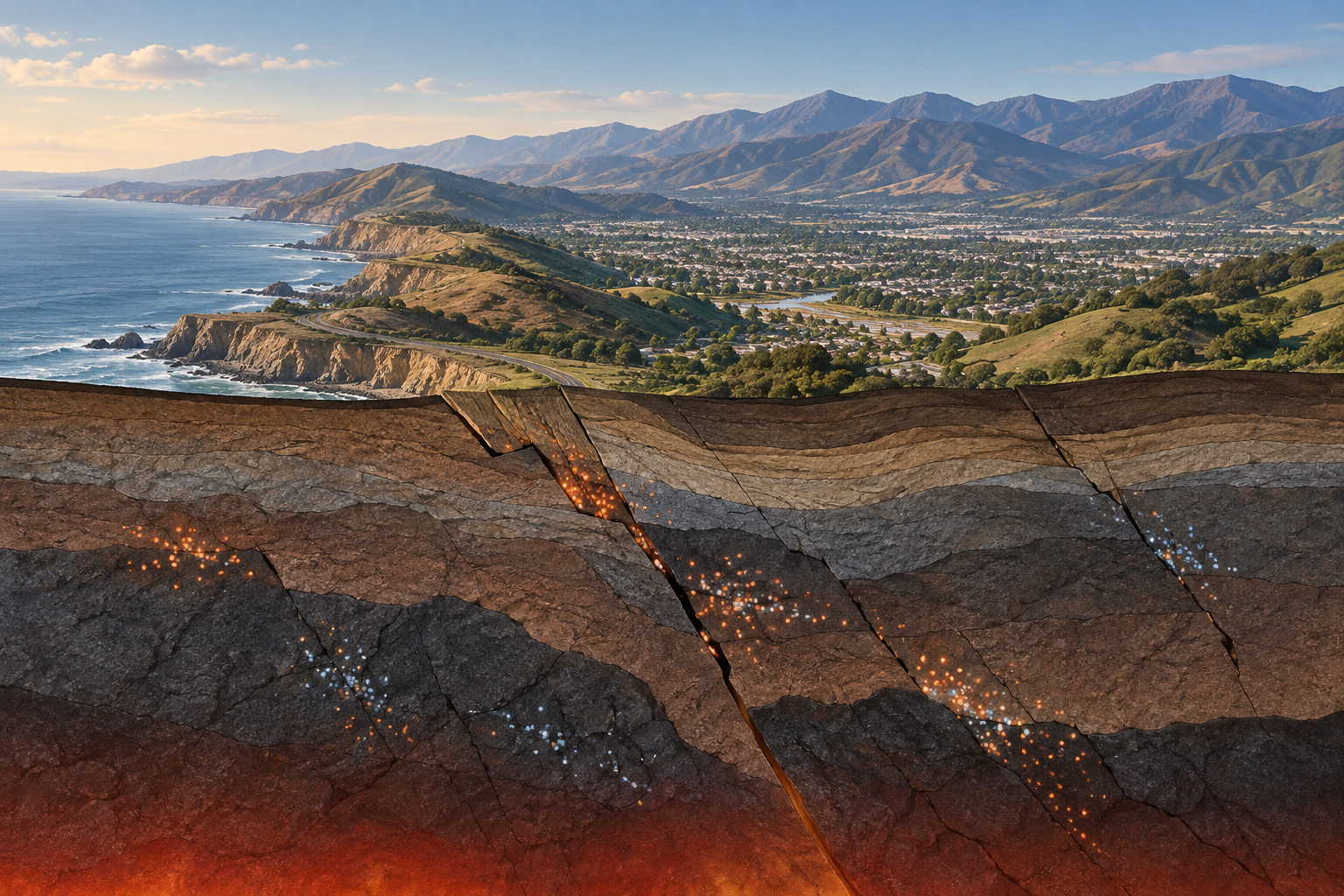
Thousands of earthquakes make an arresting headline. But the number alone cannot tell Californians whether a catastrophe is approaching. There is an important distinction between substantial long-term earthquake hazard, a local burst of seismic activity and evidence that a particular major earthquake is imminent. Recent clusters do not establish that last claim: the U.S. Geological Survey cautions that fluctuations in earthquake numbers are not, by themselves, evidence of an impending large earthquake. [1] [4]
What the earthquake tally actually says
The California Geological Survey reported 7,814 earthquakes of magnitude 1.5 or greater in its 2024 summary. Of those, 1,046 reached magnitude 2.5 or greater, and 17 reached magnitude 4.5 or greater. These categories are nested: the larger earthquakes are already included in the lower-threshold totals. Adding the three figures would count some events more than once. [2]
A meaningful comparison needs consistent dates, geographic boundaries, magnitude thresholds and treatment of aftershocks. Better instruments can also increase the number cataloged without a corresponding increase in underlying activity. The research behind this article verified the official 2024 figures, but not comparable statewide totals for 2025 or January 1–October 24, 2026. It therefore cannot establish a statewide increase across those years. [1] [2]
There were nevertheless significant events. The magnitude-7.0 offshore Cape Mendocino earthquake on December 5, 2024, was the largest U.S. earthquake that year. California’s largest onshore earthquake of 2024 was the magnitude-5.2 Lamont event near Bakersfield, which was widely felt but caused little damage. These events warrant serious coverage; their occurrence alone does not demonstrate that a larger disaster is approaching. [2] [1]
A swarm is not a countdown
San Ramon’s 2025–2026 swarm illustrates why context matters. In a February 2026 explanation, USGS scientists Jessica Ball and Alicia Hotovec-Ellis described earlier San Ramon Valley swarms in 1970, 1976, 1990, 2002, 2003, 2015 and 2018. The current activity has historical precedents. They also addressed another alarming interpretation: it is not evidence of an awakening local volcano, because there is no active volcano nearby. [3]
That does not make every small earthquake irrelevant. Globally, USGS reports that an earthquake has about a 5% chance of being followed by a larger earthquake nearby within a week. But this broad average is not the chance that any particular California tremor will precede a magnitude-7 event. Forecasts tailored to an individual sequence can provide more appropriate estimates. [5]
What scientists can learn from clusters
A peer-reviewed study first published March 24, 2026, examined ten years of Southern California earthquake clustering. Nicolas D. DeSalvio and Wenyuan Fan of Scripps/UC San Diego, with USGS researchers Andrew J. Barbour and Jeanne L. Hardebeck, used statistical burst detection and comparisons with other geophysical datasets to investigate compact episodes of seismic activity. [6]
The bursts concentrated particularly along the San Jacinto Fault and in the Salton Sea and Coso geothermal fields. They often occurred within a five-kilometer radius and lasted less than ten hours. Their characteristics differed from surrounding earthquake activity, suggesting temporary processes within fault zones. This was observational research into clustering, not a demonstrated prediction method. The findings summarized here come from the abstract and plain-language summary, rather than a full-paper review. [6]
The risk worth taking seriously
California’s long-term hazard remains substantial regardless of cluster headlines. A USGS-led working group estimated a 72% probability of at least one magnitude-6.7-or-larger earthquake somewhere in the San Francisco Bay region during 2014–2043. That is a forecast for a specific region and period—not a fresh 30-year forecast starting today, and not a prediction of an exact date or fault rupture. [4]
The defensible conclusion lies between alarm and dismissal. Local activity can intensify, further nearby earthquakes remain possible, and long-term hazard is substantial. None of those facts turns a recent swarm into proof that the Big One is imminent. Good earthquake reporting keeps counts, forecasts and predictions separate—and makes clear what the evidence cannot tell us. [1] [4] [5]
Sources
- [1] Why are we having so many (or so few) earthquakes? Has naturally occurring earthquake activity been increasing? | U.S. Geological Survey
- [2] Geology News (CALIFORNIA GEOLOGY Magazine, volume 55 (2024))
- [3] Earthquake swarms in California: What’s the difference between magmatic and tectonic? | U.S. Geological Survey
- [4] Earthquake outlook for the San Francisco Bay region 2014–2043 | U.S. Geological Survey
- [5] What is the probability that an earthquake is a foreshock to a larger earthquake? | U.S. Geological Survey
- [6] Compact Seismicity Bursts Have Different Characteristics From Regional Seismicity - DeSalvio - 2026 - Journal of Geophysical Research: Solid Earth - Wiley Online Library