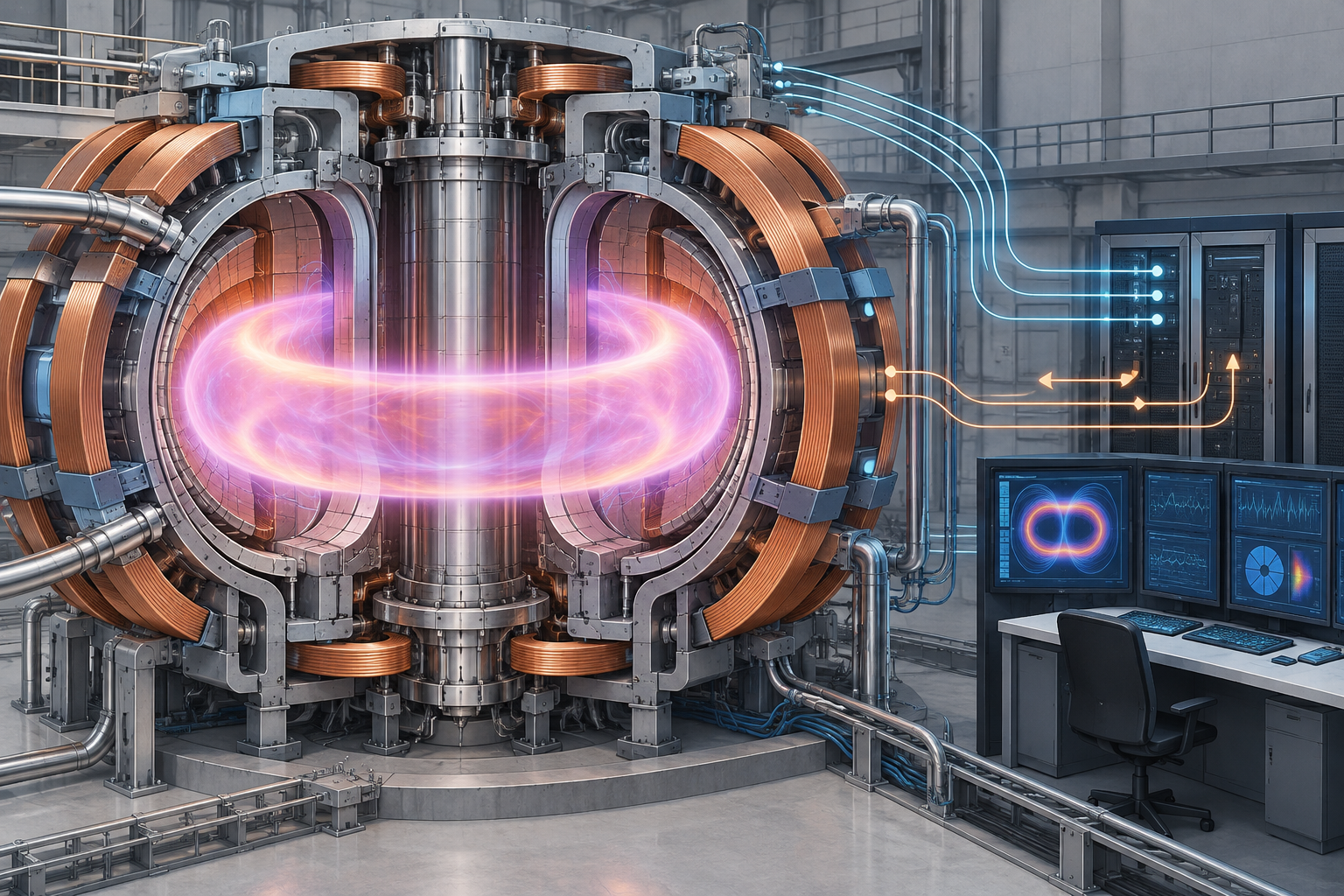
An AI controller in a fusion experiment asked for less heating. There was a problem: the heating equipment was already at its permitted minimum. The requested adjustment was unavailable, and the plasma subsequently became unstable. Reported alongside successful experiments, that failure captures both the promise and the practical difficulty of using AI for fusion control. [6]
Researchers have used AI to control real fusion plasmas—not merely simulated ones. They have demonstrated magnetic-shape control and avoidance of a particular instability. More recently, a framework called PACMAN has connected multiple AI tools to an experimental tokamak’s existing control system. These are advances in operating research machines, not demonstrations of commercial fusion electricity. [1] [2] [5]
Learning to act before trouble develops
In a study published in Nature in February 2024, a Princeton and Princeton Plasma Physics Laboratory team tested an AI controller at the DIII-D tokamak in San Diego. A neural network learned plasma responses from experimental data. Researchers then used that model as a simulated training environment for a reinforcement-learning controller before deploying it on the machine. [5] [6]
The controller used measured plasma profiles to adjust neutral-beam heating power and plasma triangularity, a feature of its shape. In a reference discharge, a tearing instability appeared at about 2.6 seconds, followed by a disruption at 3.1 seconds. An AI-controlled comparison avoided disruptive tearing throughout the scheduled operating phase. It also outperformed a more conservative reference when performance was accumulated over time. [6]
But another AI setting produced the heating-limit failure. The minimum permitted beam power had not been incorporated during training. The lesson was concrete: learning how plasma responds is not enough if training leaves out the limits of the equipment being commanded. The authors described the work as a proof of concept requiring further experiments and tuning. [6]
From individual controllers to shared infrastructure
PACMAN addresses a related engineering challenge: connecting control tools to the operating machine. Developed by researchers at Princeton, PPPL and Japan’s National Institutes for Quantum and Radiological Science and Technology, it links diagnostic measurements, predictive models, controllers and actuator commands within DIII-D’s existing system. The journal paper appeared in July 2026; PPPL publicized it in September. Those accounts describe the same research, not independent confirmations. [2] [3]
Its five reported applications span heating control, tearing-mode avoidance, prediction of edge-localized energy bursts, control of waves driven by energetic particles, and plasma-profile control. That list does not mean one AI simultaneously mastered every task. Some applications combine machine learning with conventional control algorithms. The contribution is reusable infrastructure rather than simply another standalone predictor. [2]
PPPL reports a typical framework cycle of roughly 20 milliseconds and an example predicting a tearing mode about 200 milliseconds ahead. These are different measurements: computational cycle time and advance warning. Hardware-command limits remain enforced, but the authors say PACMAN is unsuitable for events such as vertical displacement events that can evolve on sub-millisecond timescales. [3] [4]
Real hardware, bounded claims
An earlier milestone came in 2022, when DeepMind and EPFL researchers transferred reinforcement-learning controllers from simulation to Switzerland’s TCV tokamak. The controllers commanded magnetic coils to regulate plasma position, current and shape. Demonstrations included maintaining two separate plasma “droplets” simultaneously. This was a simulation-to-hardware achievement in magnetic control—not net energy production or comprehensive suppression of plasma instabilities. [1] [7]
Speed remains another constraint. An October 2026 preprint benchmarking ten fusion-related neural networks or model components found that tested CPU backends took tens to thousands of milliseconds for models above five million parameters; GPUs were substantially faster. The authors also highlighted timing variability: an occasional delay can matter in a feedback loop. This was a computational benchmark, not a new plasma-stability experiment. [8]
Together, these studies show progress from individual demonstrations toward integrated experimental control. They do not establish universal reliability. Successful control still depends on which instability is being addressed, how quickly it evolves, and whether the controller can act within the machine’s real limits. [2] [4] [6]
Sources
- [1] Magnetic control of tokamak plasmas through deep reinforcement learning | Nature
- [2] (PDF) Enabling integrated AI control on DIII-D: a control system design with state-of-the-art experiments
- [3] PACMAN AI framework for controlling fusion systems safely makes key decisions in milliseconds | Princeton Plasma Physics Laboratory
- [4] Enabling Integrated AI Control on DIII-D: A Control System Design with State-of-the-art Experiments
- [5] Avoiding fusion plasma tearing instability with deep reinforcement learning | Nature
- [6] Avoiding fusion plasma tearing instability with deep reinforcement learning
- [7]
- [8] Is Your AI Fast Enough to Run a Fusion Reactor?