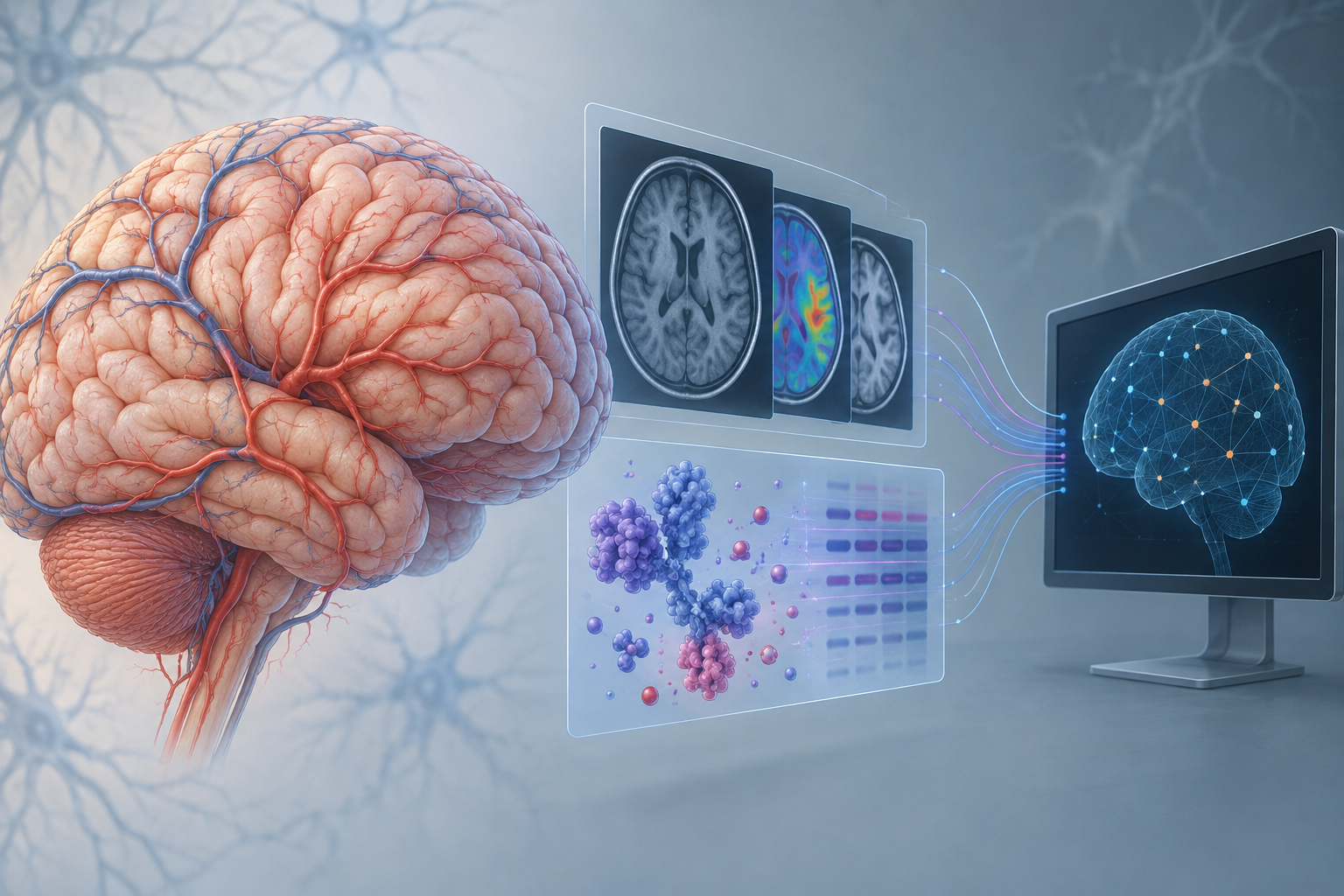
Distinguishing the causes of dementia is not the same as finding a cure. Artificial intelligence is showing promise at the first task: separating conditions that can look similar or occur together. But the research reviewed here does not demonstrate an AI-developed treatment that reverses established vascular dementia. That distinction matters when impressive diagnostic results become hopeful headlines. [1] [3] [5]
Vascular dementia involves damage to the brain’s blood vessels or blood supply. No established treatment reverses the underlying brain injury. Current care addresses symptoms and conditions that can contribute to further damage, including high blood pressure, diabetes and other stroke risks. Alzheimer’s disease can coexist with vascular dementia, complicating both diagnosis and treatment. [2] [3]
What AI has actually demonstrated
In a 2024 Nature Medicine study, a Boston University–led team developed and evaluated an AI system using information from 51,269 people across nine datasets. Its inputs included medical histories, cognitive tests, assessments of everyday functioning and brain imaging. It considered ten categories of underlying causes, including vascular dementia and normal-pressure hydrocephalus. [1]
The system achieved an overall AUROC of 0.96—a measure of how well it distinguished categories across possible decision thresholds, not a finding that 96 percent of patients were correctly diagnosed. Performance was weaker when two causes coexisted, with a mean AUROC of 0.78. In a 100-case comparison, combining model predictions with neurologists’ assessments improved diagnostic discrimination. [1]
Better identification could help researchers select appropriate trial participants rather than group biologically different conditions together. But this study analyzed existing research data. It did not show that AI-guided care preserved memory or independence; the authors called for prospective studies to establish patient benefit. [1]
A March 2026 Nature Medicine study explored blood proteins. Its ProtAIDe-Dx model used measurements from 17,187 participants to assess six neurological conditions, reporting cross-validated balanced accuracy of 70 to 95 percent, depending on the condition. Crucially, the dataset lacked vascular-dementia diagnoses: stroke or transient ischemic attack represented cerebrovascular disease instead. Performance also worsened in more demanding tests across research sites. These findings do not establish a standalone vascular-dementia test, much less a treatment. [5]
Treatment signals need confirmation
Drug research extends well beyond AI. A pipeline survey published in May 2026 identified 88 trials involving 62 drugs, including 24 phase 3 trials. Its cutoff, however, was August 22, 2025, and the trials lacked published peer-reviewed results at that point. This was not a list of successful therapies. The authors reported no approved medicines specifically for vascular cognitive impairment and dementia. [4]
One encouraging experiment was LACI-2, a randomized study of 363 people after lacunar stroke, which affects small vessels deep in the brain. Alongside standard stroke-prevention care, participants received isosorbide mononitrate, cilostazol, both or neither. At one year, isosorbide mononitrate showed a favorable cognitive signal, while the combination showed favorable cognitive and functional signals. [6]
However, LACI-2 primarily tested feasibility. Participants knew their treatment, and efficacy findings were secondary outcomes. Neither drug alone significantly improved the composite clinical outcome, and the trial did not establish reversal of diagnosed vascular dementia. [6]
Another trial, COMCID, found that cilostazol did not improve its primary cognitive outcome in 159 people with mild cognitive impairment. Different populations, doses and designs mean this does not directly refute LACI-2, but it reinforces the need for confirmation. Neither trial was an AI-discovered treatment breakthrough. [6] [8]
Why the precise diagnosis matters
Normal-pressure hydrocephalus deserves separate consideration. In a 2025 blinded randomized trial, 99 selected patients whose walking improved after temporary fluid drainage received active or placebo shunt settings. Active drainage improved walking speed and balance at three months, but showed no statistically significant advantage in cognition or bladder symptoms. Headaches and bleeding complications were more frequent with active drainage. [9] [10]
The central distinction is between identifying a condition and changing its course. AI has demonstrated useful diagnostic capabilities; whether those capabilities improve memory or daily functioning remains unproven. Clarifying the diagnosis and addressing risks of further vascular injury are useful steps now—not substitutes for a cure, but better-grounded options than promises of an AI rescue. [1] [2]
Sources
- [1] AI-based differential diagnosis of dementia etiologies on multimodal data
- [2] Vascular Dementia - Vascular Dementia | NHLBI, NIH
- [3] Vascular Dementia: Causes, Symptoms, and Treatments | National Institute on Aging
- [4] Vascular cognitive impairment and dementia drug-development pipeline 2025 - PubMed
- [5] A deep joint-learning proteomics model for diagnosis of six conditions associated with dementia | Nature Medicine
- [6] Isosorbide Mononitrate and Cilostazol Treatment in Patients With Symptomatic Cerebral Small Vessel Disease: The Lacunar Intervention Trial-2 (LACI-2) Randomized Clinical Trial | Trials | JAMA Neurology | JAMA Network
- [8] Efficacy and Safety of Cilostazol in Mild Cognitive Impairment: A Randomized Clinical Trial | Neurology | JAMA Network Open | JAMA Network
- [9] A Randomized Trial of Shunting for Idiopathic Normal-Pressure Hydrocephalus | New England Journal of Medicine
- [10] A Randomized Trial of Shunting for Idiopathic Normal Pressure Hydrocephalus